
LED Wall Virtual Production: The Tech Behind The Mandalorian
Filming inside a wall of LED panels is not a better green screen. It changes the order in which decisions get made on a shoot, and moves budget from post-production to preparation.
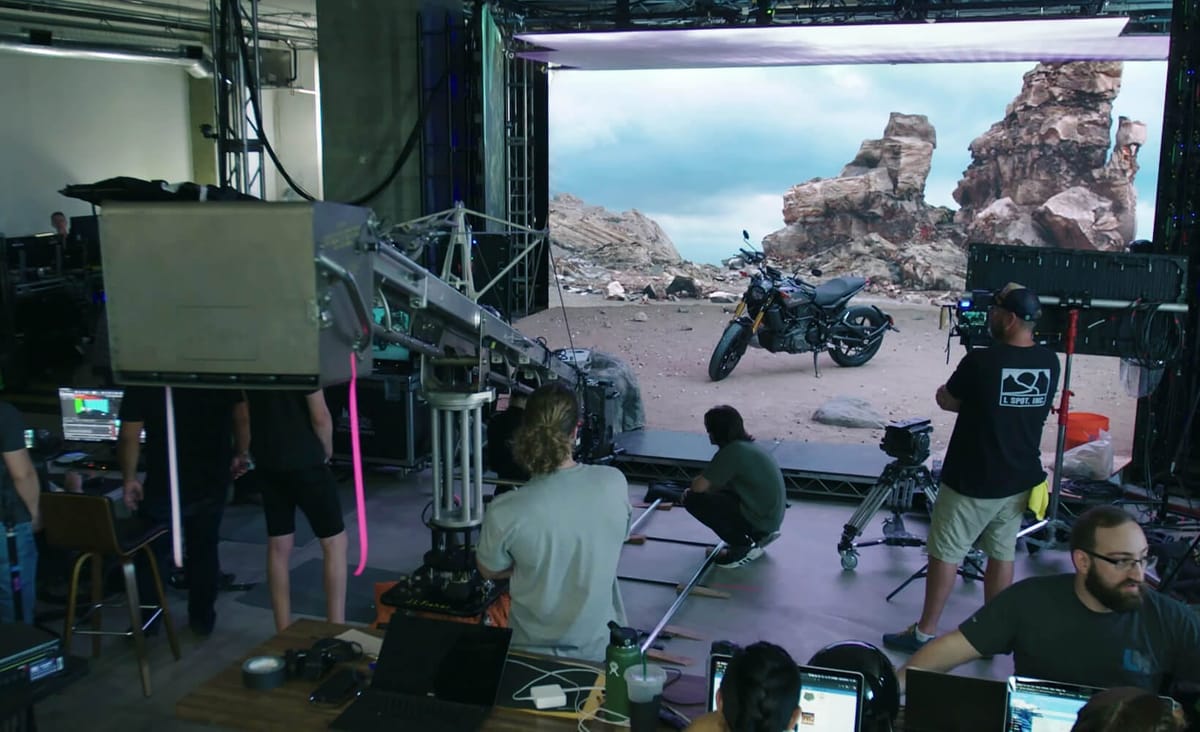
When The Mandalorian premiered in 2019, most viewers assumed the desert vistas behind the characters were the usual mix of location plates and green screen. They were neither. The actors were standing inside a curved wall of LED panels displaying a photorealistic environment that redrew itself, in real time, according to where the camera was pointing. The technique now has a name — virtual production — and it has spread from episodic television to commercials, music videos and feature work.
Calling it a better green screen misses what actually changed. The LED wall does not simply replace a backdrop; it rearranges the order in which decisions get made on a shoot, and it moves a large part of the visual effects budget from post-production to preparation.
What LED wall virtual production actually is
Virtual production covers any method that combines computer-generated imagery with live action at the moment of shooting rather than afterwards. Its most visible form is in-camera visual effects: the stage is surrounded by large LED panels, usually arranged as an arc — the Volume — that display a virtual environment the camera photographs directly.
The Volume built for The Mandalorian measured roughly 23 metres across and 6 metres high, with an LED ceiling closing the space overhead. Performers work inside the set rather than in front of it, lit by the light the panels themselves emit.
How the real-time rendering works
The system rests on a game engine, in practice most often Unreal Engine, where the environment exists as an interactive three-dimensional scene. Four pieces of technology have to cooperate for the illusion to hold.
Camera tracking continuously reports the position and orientation of the physical camera in the stage volume, whether through optical markers, infrared sensors or mechanical encoders on the crane.
Real-time parallax uses that tracking data to recompute the perspective of the environment shown on the wall. As the camera moves, the background shifts as a real location would, which is precisely what a flat backdrop cannot do.
The frustum is the portion of the wall the camera is actually framing. Only that region is rendered at full quality and in correct perspective; everything outside it displays a lower-cost version of the scene whose job is to light the set rather than to be photographed.
Genlock synchronises the camera shutter with the panel refresh so the two never drift apart. Without it, the footage tears and flickers in ways no amount of post-production will repair.
Why lighting is the real breakthrough
The decisive advantage over green screen has nothing to do with the background and everything to do with light. An LED wall is not only an image: it is a large, soft, coloured light source whose output matches the environment being displayed.
That matters most on anything reflective. A helmet, a car body, a pair of glasses, a wet street — all of them pick up reflections that correspond exactly to the scene behind them, without a compositor having to invent those reflections later. The green spill that contaminates hair and costume on a chroma key set simply does not occur, because there is no green.
It also changes the pace of a shoot. Moving a virtual sun, changing the time of day or switching the weather takes a few seconds at the console, and the lighting on the performers follows automatically. A crew can shoot a permanent magic hour for as long as the schedule allows, which on location would be a twenty-minute window per day.
What a Volume is made of
| Component | Role |
|---|---|
| High-density LED panels | Display the environment; a fine pixel pitch, typically 1.5 to 2.8 mm, limits moiré |
| Processing hardware | Drives the panels and handles colour calibration across the wall |
| Render nodes | Compute the real-time three-dimensional scene |
| Camera tracking system | Locates the camera — optical, infrared or mechanical |
| Synchronisation server | Aligns camera frames with panel refresh through genlock |
| Art department console | Adjusts environment, lighting and weather live on set |
The limits nobody puts in the showreel
Moiré. The pixel grid of the wall and the sensor grid of the camera interfere with each other, producing patterns that appear and disappear with focal length and distance. Finer pitch panels reduce the effect considerably without eliminating it on tight shots.
Depth of field. The wall sits at a fixed distance, so the background is optically flat however convincing it looks. Aperture, focal length and the distance between performer and panel have to be managed together, and shallow depth of field is both a tool and a trap.
Preparation. Environments must be finished, optimised and tested before the first day of photography. Previsualisation stops being a nice-to-have and becomes the critical path: a location you have not built does not exist, and cannot be improvised on the morning.
Cost. A permanent Volume is a heavy capital investment that only pays back across a high volume of effects shots. Day-rate LED stages have made the technique reachable for commercials and music videos, which is where most of its growth now happens.
When it is the right tool
Virtual production earns its keep when the location is inaccessible, dangerous, expensive or imaginary — vehicle interiors, spacecraft, alien landscapes, period exteriors — and when a production needs many different environments without moving the crew. It is equally valuable whenever reflective surfaces or precise lighting continuity would make a green screen composite painful.
It is the wrong tool for an intimate scene in natural light, for anything requiring genuine depth behind the subject, and for productions whose environments will not be locked in time for the shoot. In those cases a real location, or a conventional green screen, remains simpler and cheaper.
Frequently asked questions
Does an LED wall replace green screen?
No, it complements it. Green screen remains the better choice for complex compositing, for shots that need to be relit entirely in post-production, and for tight budgets. The LED wall wins on realistic interactive lighting and on delivering a finished shot in camera.
Is Unreal Engine mandatory?
It dominates the market but it is not a requirement. What matters is a real-time renderer that is photorealistic, frame-accurate and capable of responding to camera tracking data without dropping frames.
Can smaller productions use an LED wall?
Increasingly, yes. Full Volumes remain expensive, but LED stages rent by the day and compact configurations — a single wall rather than a full arc — cover a large share of commercial and music video work.
Is moiré still a problem?
Much less than it was. Fine pixel pitch, careful choice of focal length and sensible distance from the wall reduce it substantially, though it can still appear on very tight shots, which is why close-ups are often plated separately.
Further reading
- Green Screen and Chroma Key: How to Get a Clean Key — the four decisions that make or break a chroma key
- What AI Still Can't Do in Video — the documented limits of generative video
- Why Google Isn't Indexing Your Videos — the rule that decides whether Google indexes your video


